Permafrost by Alastair Reynolds (published 2019)
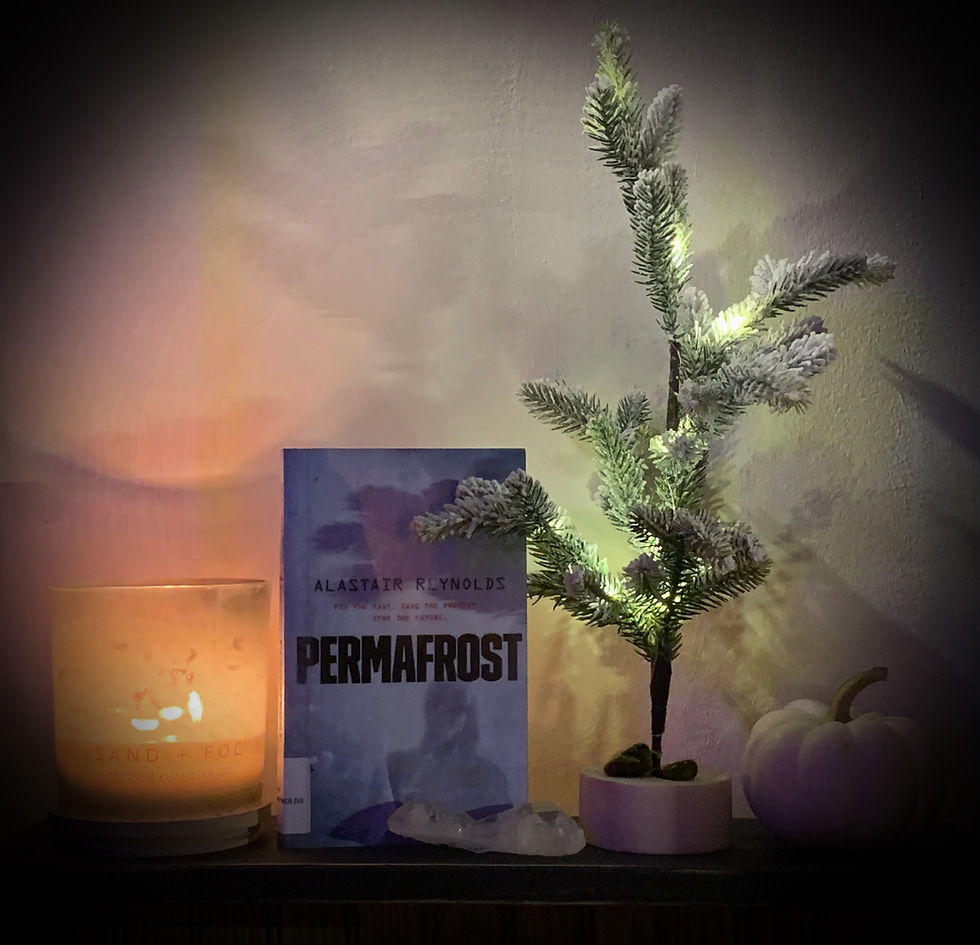
By the time the story of Permafrost takes place, things have gotten bad. Really bad. After a slow, barely noticed (at first) event they call The Scouring in which insect life goes extinct and up the food chain from there, virtually destroying the capability of life on the planet, certain individuals are called upon to do a violent, risky job - by using a new method of time travel - to save life on Earth in the form of seeds, seeds to be hidden and planted in ice (the permafrost), saved as potential to hopefully grow and flourish at a later time.
Though this premise, give or take, seems almost ubiquitous in the realm of Science Fiction, you wouldn't even be able to grasp at this to begin. Reynolds starts in the middle of the action without any real plot foundations at the outset: just the movement of characters through time, a person shot by a driver at the wheel of a moving car, amidst a landscape of industrial complexes, ice, and desolate fields that hold the last semblances of nature. Going into a narrative in such a way - as if airborne - is not easy, yet it happens over and over again in real life as a coming to terms with how notions of origin are disappearing while modern histories come apart at the seams. Isn't this what good contemporary Science Fiction does?
Whether or not an event like the Scouring is a real possibility (which it appears to be, given the Climate Emergency and its effects), Permafrost's realism stands. Reynolds doesn't write characters by putting personal identities at the forefront, but by describing their work as the reason they are valid and valuable, and unfortunately, not much else besides. Call it reductive, stripped down, or lacking but it is a kind of subjectified nakedness that uses all that it is left with to make a difference. Thankfully, these characters aren't presented as programmed robots but as actual people who genuinely care about the dangerous jobs they have and its mission. Why they still care, about the Earth and their presence with one another, is up for debate. Are there souls at stake?
"'I want to help.
'You are helping. Just by existing, just by giving us a means to make the changes we need to... that's enough.'
'No. More than that, You told me my life's a series of screwups. Part of me wants to disbelieve you but there's another part that says, yes, let's face it, she's probably right. And I do believe the rest of it. I'd rather accept that there's a time traveller in my head, if it's a choice between that and going mad.'
'You're not going mad. Not more than the rest of us anyway.'
'Then I'm helping.'
(p. 118)
They travel through time by inhabiting another person's brain from the past. Tatiana wakes up in a hospital and hears a specific voice in her head - Valentina Dinova's - speaking to her from the future, guiding her through what to do and changing the trajectory of time through her body. Tatiana's job is to take care of the seeds and then hide them in ice so they can be preserved for use in the future. This task is within the project called Permafrost, headed by a Dr. Cho of the World Health Organization: the only surviving organization against the disappearance of the Earth. The moral and ethical implications of this procedure are unwritten by Reynolds: but there is much to mull over when considering how time travel in this instance could be used for heinous (and perhaps political) abuse.
"Something bad happens around 2050. At first, we almost don't notice it, There's a steepening in the rate at which insect species are going extinct, but even then it just seems to be part of a pattern of something that's been going on for a long time, and to begin with only a few scientists are really worried. But it gets worse, and really quickly. No one really understands what's happening. There's talk of horizontal gene-transfer, of some rogue mutation, perhaps some deliberate thing, a biological weapon gone haywire, hopping from one insect species to the next. Shutting them down, like a computer virus." (p. 112)
Hard science fiction concepts are introduced to flesh out what's happening within the project: grandfathering (a slowing down of time as a result of an unexpected occurrence), paradox noise (an atmospheric quality that can trap the subject unless s/he finds a way to resolve it logically), upstream/downstream time (the movement and mapping of time as a linear entity), Luba pairs (the host body and it's inhabitant, including the voice and visual realm), and causal lag (jumping to differing places throughout time, with the possibility of contradictory results that create a singular, but delayed result). If the addictive adrenaline of the story isn't enough, maybe the desire to fully understand these concepts and how they play out might be the reason to read the story a second or third time. The result is a novella that reads as if a crystallized object to interpret, similar to a single icicle or a piece of rare mineral earth that can be looked at in its totality, or detail by infinite detail.
"The alterations happened naturally, time murmuring to itself like a old house, but they could also be generated by artificial interventions... a pattern of changes would ripple through the lattice, the future changing the past, the past changing the future, the future returning the favor, like a series of dying echoes, until a new configuration held sway." (p. 78)
Of everything within the Permafrost project, the most troubling of all might be the four Brothers, machines named after the four brothers Karamazov programmed to aid the project by mapping coordinates/directions so those within Permafrost can safely secure the seeds. The Brothers, after a certain point, end up working against the project: their programming so automatically embedded (similar to how ideology works) that the only logical (and ironic) conclusion becomes a discontinuation of mapping and planning and reverts instead to keep the seeds hidden from the very workers of the same Permafrost project. Virtually aimless should this have been the end result, the members of Permafrost destroy the machines and do the job themselves.
"Each had been reduced to a broken, cracked-up stump, with smoke and sparks still issuing from the grilles at their bases. When we had broken the casing, we had dug deep into their interiors, wreaking all the havoc we could. The machines were dead to the eye, wounded to their vital cores. They looked more like geology than technology." (p. 159)
No spoilers but, by the end of all the violence physically, psychologically, and by the end of all the destruction, towards nature and the machine, there is a resolution of time that emerges, only by force, for the possibility of a live connection.


Comments